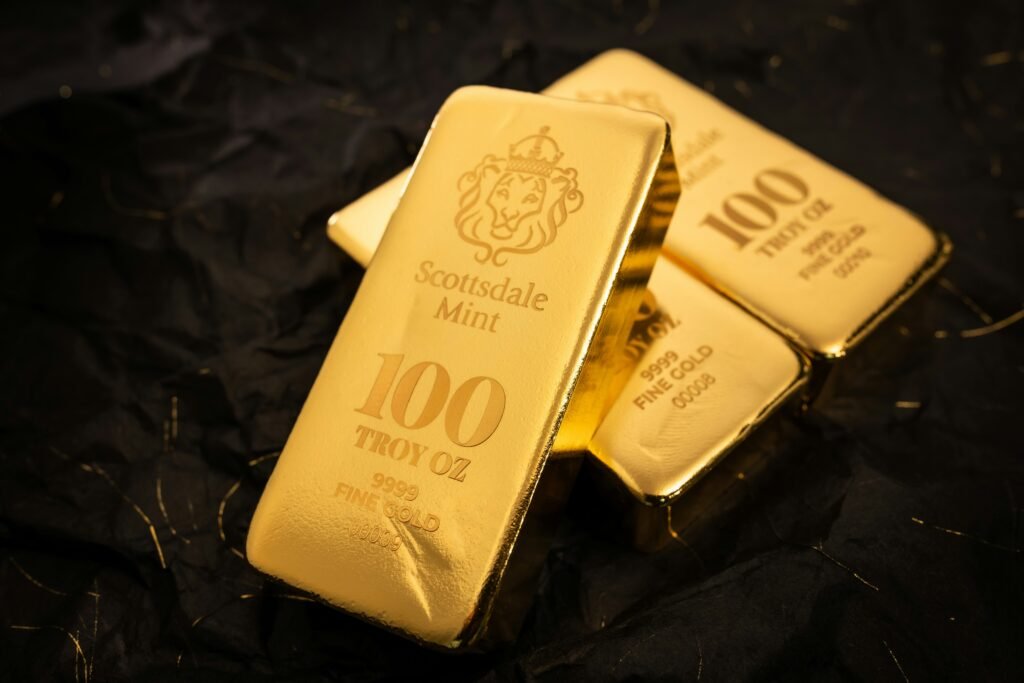
Introduction
There is often discussion in social media as to whether the world may, or could, return to the gold standard. Prior to World War 1, from approximately 1870 to 1914, the world’s economies operated under the `Gold Standard’. Under the Gold Standard, the price of gold was fixed so that most currencies were convertible directly into gold at fixed rates. Therefore, exchange rates between nations were also fixed. This article focuses on the history of the gold standard and how the creation of the post-WW2 Bretton Woods system, along with its dismantling, changed the way gold was priced and affected global economies.
Pre World War 1
Before World War 1, the fixed exchange rates around the world, under the gold standard, had the advantage of encouraging world trade because uncertainty of fluctuating exchange rates was eliminated. In Canada, for example, one could convert $20 into 1 ounce of gold, which could also purchase 4 British pounds, because 5 Canadian dollars was approximately equal to 4 British pounds. Since nations followed the rules of the gold standard by backing their currencies with gold, exchange rates could remain fixed. Paper money was freely convertible into gold. Britain led the way, and other nations followed, as gold became the universal monetary anchor. The disadvantage, however, was that nations had less control over their monetary policy. A country’s money supply was a function of gold flow between countries. [1]
In theory, the Gold Standard worked, as long as global gold production was low and the growth of the money supply was then also low. What happened when gold production accelerated? When more gold was discovered, the money supplies increased rapidly and therefore price levels also rose, which led to inflation. In the 1870s and 1880s, when gold production was low, the money supply could not keep up with growth of the global economy, which led to deflation. [1] Further, the outbreak of World War 1 in 1914 forced nations to suspend gold convertibility and finance miliary spending. Clearly, the Gold Standard did have limitations.
Post World War 2
Following World War 2, a global fixed exchange rate system was set up which became known as the Bretton Woods system. This system had 30 original members (in 1945) and created the International Monetary Fund (IMF). The primary role of the new IMF was to promote growth of world trade and govern the compliance of countries of maintaining fixed exchange rates. The Bretton Woods agreement also created the World Bank which would provide loans to assist developing nations build infrastructure to enhance their economies. Both the IMF and the World Bank made loans to nations around the world.
After World War 2 ended, the United States owned the largest share (two thirds) of the world’s gold and had over half of the world’s manufacturing capacity. It clearly had become the world’s largest economic power. As a result of its gold possession, the Bretton Woods system of fixed exchange rates was based on converting 35 U.S. dollars for 1 ounce of gold. Further, the U.S. dollar was now the world’s reserve currency; other nations used the U.S dollar to purchase U.S. dollar assets. All currencies were pegged to the U.S. dollar. [1]
During the 1950s and early 1960s, the Bretton Woods system worked fairly well, as it supported global reconstruction and trade. But as Europe and Japan recovered, U.S. gold reserves declined relative to the increasing number of dollars it held abroad. This imbalance made the system increasingly unstable.
In 1971, however, under President Richard Nixon, the exchange rate determined by the Bretton Woods system had ended. This action, known as the Nixon Shock, transformed the U.S. dollar into a fiat currency. By 1973, major currencies shifted toward floating exchange rates and the gold-U.S. dollar link was permanently severed. The U.S. dollar, however, did keep its status the world’s reserve currency.
The Response of Gold Prices Following 1971
After gold was no longer fixed at 35 U.S. dollars per ounce, its price was free to move according to market forces. In consequence, the price of gold surged throughout the 1970s as inflation also surged amongst currency instability. Gold had entered an era of market-driven pricing, reaching unimaginable levels (as we can observe today) under a fixed rate system. In summary, the post-1971 era transformed gold into a freely traded asset that became sensitive to inflation, interest rates, and geopolitical risk.
Gold Proficiency
Source:
[1] The Economics of Money, Banking, and Financial Markets, Mishkin and Serletis, Fourth Canadian Edition, Pearson Canada, pages 524 – 526
Disclaimer:
This summary is provided for educational and informational purposes only. Though it has been taken to ensure accuracy, we make no representations or warranties of the reliability of the information.
Forward-looking statements, projections and estimates are subject to risks as outlined in the original company disclosures. Readers should consult official texts for full context. Nothing in the articles constitute forecasting, investment or financial advice. Please seek guidance from a qualified professional before making any investment decisions.
Gold Proficiency