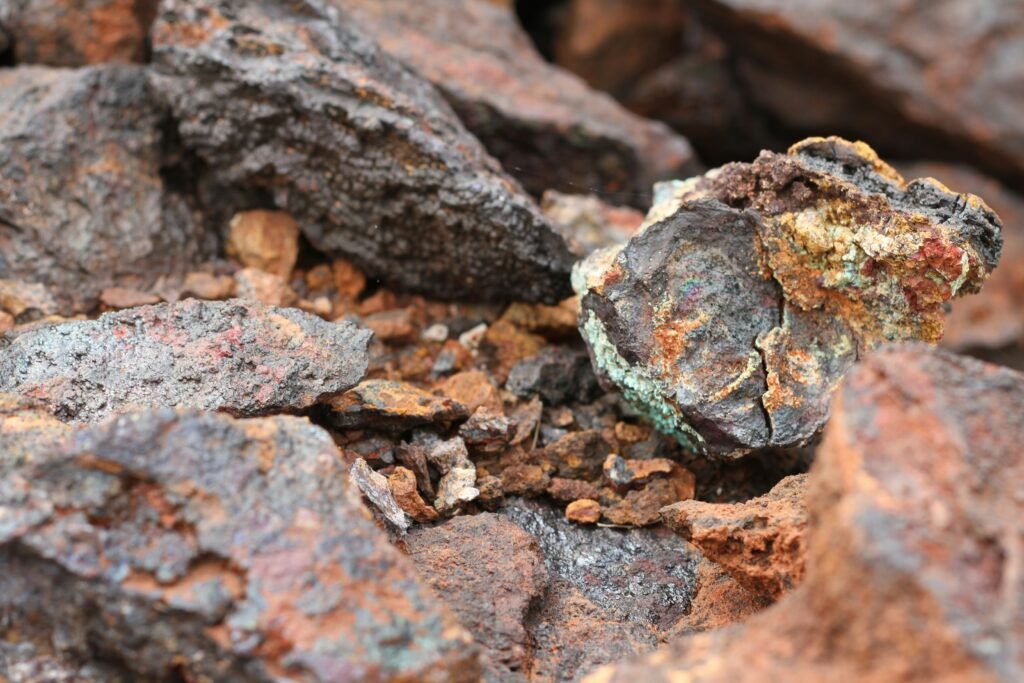
Critical minerals are those minerals essential for economic and national security, with vulnerable and concentrated supply chains, and have essential uses in technologies. Electric vehicles, batteries, semiconductors, aerospace, defense, and clean energy systems all require critical minerals. The demand for critical minerals could increase several-fold by 2040. This report discusses the mining of critical minerals in Canada and the U.S.
Overview
Natural Resources Canada and the U.S. Geological Survey define critical minerals using three main criteria:
i) Essential to modern technologies and national security
ii) High risk of supply disruption
iii) Limited or difficult substitutes
Note: In both nations, gold does not fall under the definition of “critical minerals” because it does not meet the conditions of points ii and iii. In November, 2025, the U.S. began classifying silver as a critical mineral because the nation considered its supply disruption as a high risk. To date, Canada has not classified silver as a critical mineral.
According to YahooFinance.com, the U.S. has expanded its official critical minerals list from 50 to 60 items, adding copper, uranium, and metallurgical coal. [Metallurgical coal is not on Canada’s critical mineral list.] The U.S. mining sector has had decades of restrictive land use policies; however, as policies are currently changing, incremental progress in production will likely take place.
Publications.gc.ca states that Canada produces over 60 minerals and metals at more than 200 mines, with almost 130 new projects under construction. Canada is the leading supplier of 23 minerals to the U.S., including 22 that the U.S. lists as critical. According to the International Energy Agency (IEA), the two countries maintain a Joint Action Plan on Critical Minerals Collaboration that focuses on securing supply chains.
Key Critical Minerals
Lithium
Purpose: used in lithium-ion batteries in electric vehicles and energy storage
Canada: there are proposed projects such as the Snow Lake lithium mine in Manitoba
U.S.: currently has limited production but explorations and processing expansions are ongoing in western states
- Graphite
Purpose: used for battery anodes and various industrial applications
Canada: has identified projects primarily in Quebec, Ontario, and British Columbia
U.S.: has very limited domestic mining; currently relies heavily on imports
- Nickel
Purpose: a major component of EV battery cathodes and stainless steel
Canada: has strong nickel resources in Ontario, Newfoundland and Labrador, and Quebec
U.S.: has accelerated its current projects
- Cobalt
Purpose: used in high-performance battery chemistries and aerospace alloys
Canada: has resources in Ontario, Manitoba, and Newfoundland and Labrador
U.S.: has small amounts and largely relies on imports
- Copper
Purpose: vital for electrical infrastructure, wiring, EV motos, and renewables
Canada: a major producer that has mines and new developments across provinces
U.S.: has large copper deposits in Arizona, Utah, and New Mexico; significant projects are being planned
- Rare Earth Elements (REEs)
Rare earths are actually not “rare”’ in the earth’s crust; they are as abundant as copper and zinc. They are “rare” because they rarely occur in concentrated mineable deposits, are usually mixed together and difficult to separate, and require complex chemical refining. Rare earths are a group of 17 chemically similar metallic elements and have unique magnetic, optical, and catalytic properties that are difficult or impossible to substitute.
Purpose: critical for permanent magnets in EVs, wind turbines, and defense technology
Canada: has known deposits in Northwest Territories and Quebec and is focusing on expanding production
U.S.: the Mountain Pass mine in California is the only major REE mining location; expansion is underway
- Uranium
Purpose: primarily used for fuel in nuclear power reactors; some use for industry and science as well as medical applications
Canada: as one of the world’s largest uranium producers, mining is concentrated in northern Saskatchewan; there are 5 mines that have some of the highest-grade uranium in the world, producing 13% of global uranium output
U.S.: uranium production is small but active and comes primarily from in-situ recovery (ISR) operations in central states such as Wyoming, Nebraska, and Utah.
- Metallurgical Coal
Purpose: primarily used in steelmaking
Canada: a major global exporter of metallurgical coal, with production concentrated in British Columbia and Alberta; Nova Scotia has some small-scale operations
U.S.: production is mainly in the Appalachian region and part of the Interior (West Virginia, Virginia, Alabama, Pennsylvania, Kentucky)
Summary
Canada is actively investing in critical mineral mining and processing. Its government and private sector have stated that it intends to become a global supplier and build value chains, supported by a federal strategy and incentives. Its priority minerals include lithium, graphite, nickel, cobalt, and rare earths. The U.S. is highly import-dependent for many critical minerals and, necessarily, is also boosting domestic mining and processing under federal policies. Its recent government and industry deals also aim to accelerate production and processing.
Future critical mineral demand in North America will be driven by clean energy transitions, electrification, and advanced technologies. To fully develop the wealth of critical minerals in building and maintaining supply chains, collaboration between the two nations is essential.
Disclaimer: This summary is based on publicly available information. It is provided for educational and informational purposes only. Though it has been taken to ensure accuracy, we make no representations or warranties of the reliability of the information. Forward-looking statements, projections and estimates are subject to risks. Readers should consult official texts for full context. Nothing in the articles constitute forecasting, investment or financial advice. Please seek guidance from a qualified professional before making any investment decisions.
Gold Proficiency