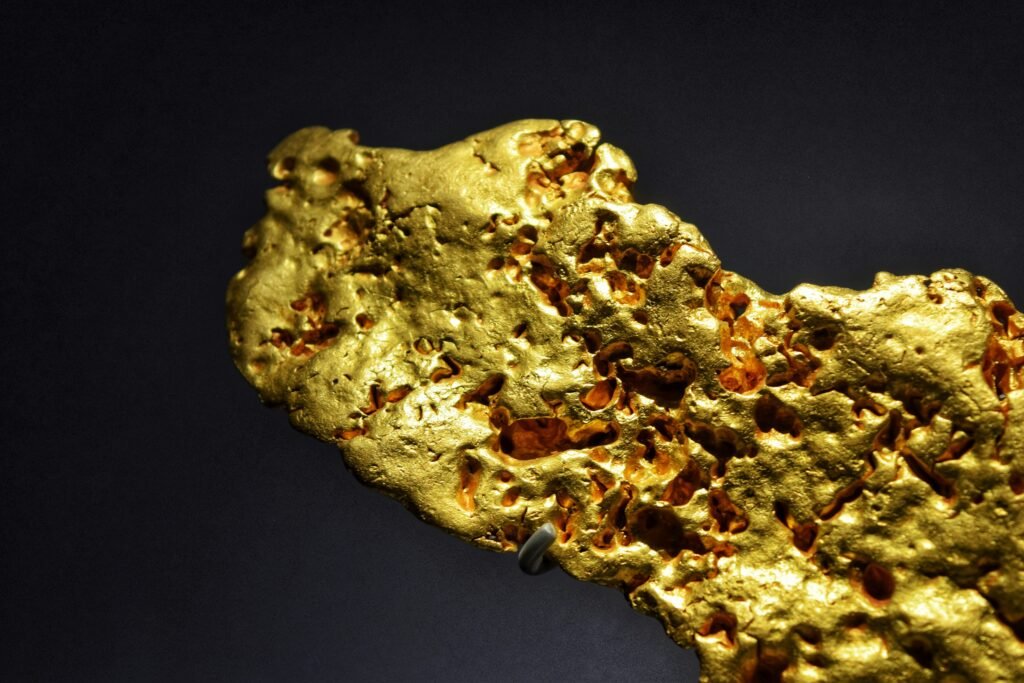
Gold Mining: A Workflow Overview
Introduction
Throughout 2025, there was much recent discussion among Canada’s politicians and media with regard to tapping into the nation’s enormous quantities of mineral wealth. This report will discuss the lengthy workflow process of gold mining from exploration to mine closure. Gold mining requires a multi-stage industrial process that transforms geological anomalies into refined bullion. Each stage has its own technical, regulatory, and economic checkpoints. Outlined below is the general full lifecycle of gold mining, drawn from industry sources.
Stages of Gold Mining Workflow
Stage 1: Exploration (1 to 10 years)
In the exploration stage, the goal is to determine whether a gold deposit exists and whether its economically viable. A number of key activities take place. First, geological surveys are initiated to map and identify anomalies and favourable rock formations. Sediment sampling of soil, rocks, and streams are also undertaken. Geophysical surveys (magnetic, gravity, IP/resistivity) and drilling programs take place to confirm grade, continuity, and tonnage [3]. Further, to estimate resources, 3-D models are constructed and NI 43-1010 compliant resource statements are made. Finally, a preliminary economic assessment provides an early-stage viability check.
Stage 2: Feasibility and Mine Planning (1 to 3 years)
During the feasibility and mine planning stage, the goal is to determine if the deposit can be mined profitably and responsibly. Components of this stage include pre-feasibility and feasibility studies such as CAPEX/OPEX modeling and NPV/IRR analysis [1] [3]. Environmental impact assessments, permitting and regulatory approvals, and mine designs are created. Mine designs will include (but not limited to) pit shells, underground layouts, haul roads, and ventilation.
Stage 3: Construction and Site Development (1 to 5 years)
Building the physical infrastructure that is required to operate the mine is the next stage. Roads, power lines, and water systems are constructed [1]. A processing plant and tailings storage facility are built. Further, pending on deposit-type, an open-pit or underground shaft/tunnel is developed [3].
Stage 4: Mining and Extraction (10 to 30 years)
Evidently, it can take many years before mining can take place. When extraction finally occurs, two types of methods are used. Open-pit mining is employed for near-surface deposits. Drilling and blasting, loading ore onto trucks, and waste rock management takes place [1] [3]. Underground mining methods are used for deeper deposits. Miners engage in shafts, declines, and drifts as well as stoping methods such as cut-and-fill, long-hole, and room-pillar [1].
Stage 5: Ore Processing and Gold Recovery
In the Ore Processing and Gold Recovery stage, gold is separated from the ore to produce a concentrate or dore bar. This process consists of a number of steps: 1) crushing and grinding to reduce ore to fine particles [1] [2]; 2) using gravity separation (optional) to recover coarse free gold; 3) leaching (cyanidation) to dissolve gold into a solution using cyanide [1]; 4) engaging in carbon adsorption whereby gold attaches to activated carbon; 5) elution and electrowinning is performed to strip gold from carbon and plate onto cathodes; 6) finally, smelting produces dore bars (a gold-silver alloy) [2].
Stage 6 : Refining
During the refining stage, dore is converted into high-purity gold. Methods include electrolytic refining, the Miller process (using chlorine gas), and the Wohlwill process (to obtain the 99.99 % purity that you will see stamped on a gold bar). Refined gold is then sold to bullion banks, mints, or industrial buyers.
Stage 7 : Tailings and Waste Management
The goal of this stage is to safely store or treat waste materials of the site. Components include tailings storage facilities (TSFs), water treatment systems, cyanide detoxification, and monitoring for seepage, stability, and environmental compliance [5].
Stage 8: Mine Closure and Reclamation (1 to 5 years)
The final stage of gold mining workflow is to restore the site to a stable and environmentally safe condition. Infrastructure is decommissioned and land is recontoured. Further steps involve revegetation, long-term water monitoring, and community transition planning [4].
References:
[1] https://www.zwccrusher.com/index.php/2025/07/09/flow-chart-of-mining-process-of-gold/
[2] https://www.mvsicrusher.com/flow-diagram-of-gold-extraction/
[3] https://www.zwccrusher.com/index.php/2025/11/08/major-steps-in-gold-mining-process/
[4] https://www.qmxgold.ca/modern-gold-production-a-comprehensive-guide-to-todays-mining-process/
[5] https://www.miningpedia.cn/mining/gold-mining-steps-complete-guide-from-exploration-to-refining.html
Gold Proficiency

Disclosure:
This summary is based on publicly available information from various sources. It is provided for educational and informational purposes only. Though it has been taken to ensure accuracy, we make no representations or warranties of the reliability of the information.